Synchronicities: Life's Algorithm
What if the universe is not silent? What if it has been speaking to you all along?

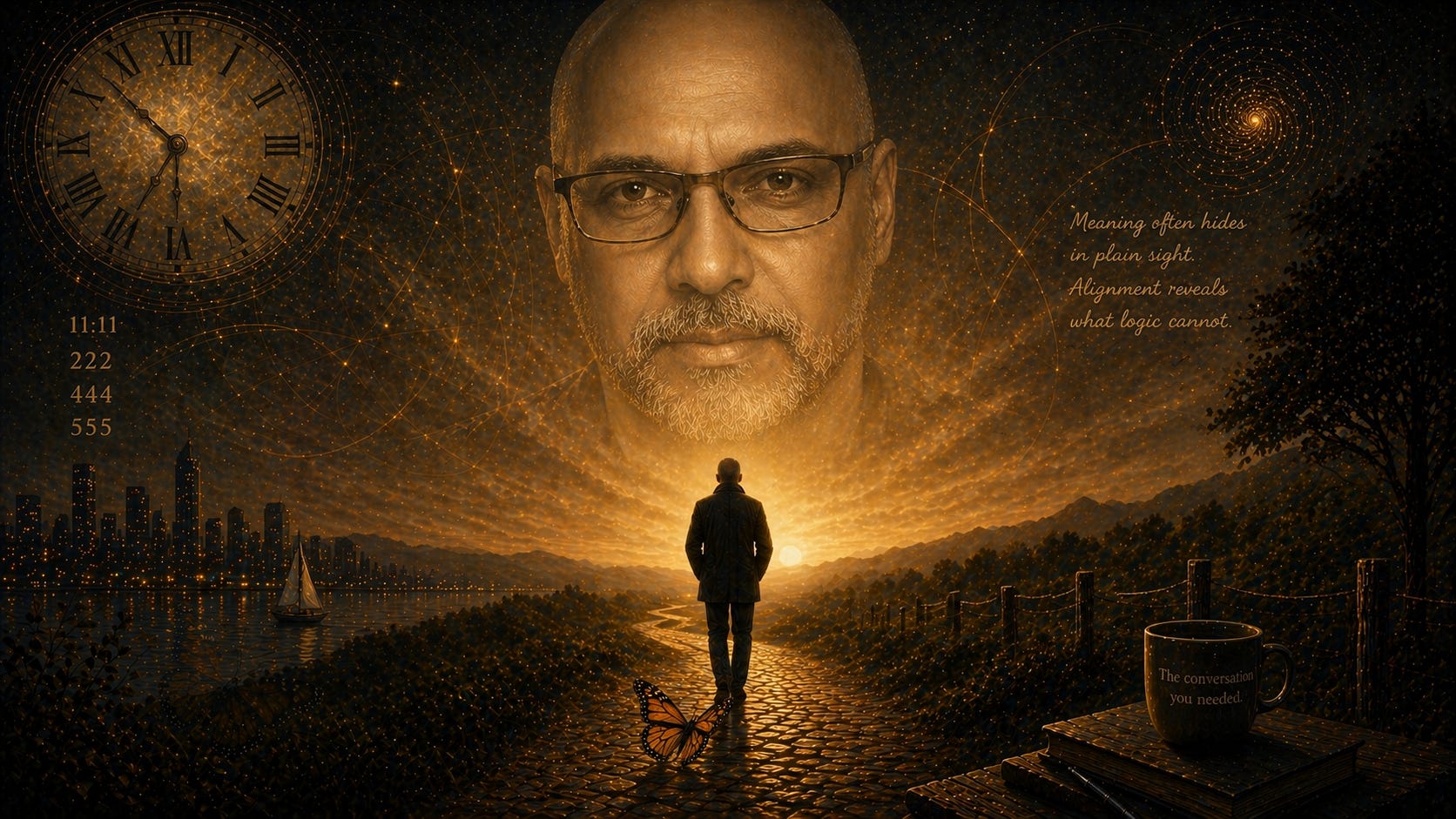
Ryan C. Neal, MD | NEUFLODOC™ Systems | The7Realms™ Framework
You think of someone you have not spoken to in three years. Within the hour, they call. You are standing at a crossroads in your life, saturated in uncertainty, and you open a book to a random page and the exact sentence you needed stares back at you. You overhear a stranger’s conversation in a coffee shop, and what they say answers the question you have been carrying for months.
You call it coincidence. You say it is random. You dismiss it before you even allow yourself to feel the weight of it. But what if dismissal is itself the disease? What if the pattern is not accidental? What if life is not a series of disconnected events but a living, responsive, intelligent algorithm, and synchronicities are the notifications it sends when you are finally close enough to the signal?
This is not mysticism dressed in borrowed language. This is one of the most rigorous and provocative frameworks in the history of depth psychology, neuroscience, and quantum theory. It is time you engaged it as seriously as it deserves.
Jung’s Thunderbolt: Naming What the World Denied
Carl Gustav Jung did not invent synchronicity. He named what had always existed and gave the scientific and psychological world the vocabulary it needed to stop pretending otherwise.
In 1952, Jung published his landmark essay “Synchronicity: An Acausal Connecting Principle,” developed alongside the Nobel Prize-winning physicist Wolfgang Pauli. The thesis was and remains radical: events can be meaningfully connected without any causal relationship between them. Two events, separated in space and time, can share significance that transcends the mechanical logic of cause and effect.
Synchronicity is not something that happens to you by chance. It is something that happens through you by design, when the architecture of your inner world and the architecture of your outer world finally achieve coherence.
The NEUFLODOC™ Framework on Jungian Synchronicity
Jung was precise in his language. Synchronicity was not merely coincidence. He defined it as a “coincidence in time of two or more causally unrelated events which have the same or similar meaning.” The operative word is meaning. Not frequency. Not probability. Meaning. The synchronous event is always, in Jung’s framework, a meaningful event. And that meaning is not imposed from outside. It emerges from the interior landscape of the person who experiences it.
This is the point that most people miss. The universe does not send universal messages to everyone. It sends personal ones. The synchronicity that arrests your attention is calibrated to your psyche, your wound, your becoming. It is, in the most literal sense, personalized data.
The Psyche as a Two-Story Architecture
To understand synchronicity fully, you must first understand the architecture Jung mapped with exceptional precision: the structure of the human psyche. It is not flat. It is not singular. It is layered, vast, and mostly invisible to the person living inside it.
The conscious mind is the floor you walk on every day. It is what you know, what you analyze, what you plan, and what you defend. It is where your ego lives. The ego is not your enemy, but it is a poor cartographer. It can only map what it can see, and it cannot see very far.
Beneath the conscious floor lies the personal unconscious. This is the repository of everything you have experienced, suppressed, forgotten, and refused to integrate. Your wounds live here. Your unlived potential lives here. Your shadow, which Jung described as the totality of everything the conscious mind refuses to acknowledge, lives here.
And beneath the personal unconscious lies what Jung considered the most profound discovery of his career: the collective unconscious. This is not your unconscious. This is the unconscious that belongs to the species, to humanity across time, encoded in what he called archetypes. These are primordial patterns of experience, universal templates of meaning, shared across cultures, generations, and epochs. The Hero. The Wound. The Great Mother. The Shadow. The Self. These are not metaphors. They are structural features of the human psyche, as real as the limbic system and as ancient as language.
The Jungian Architecture of the Psyche
The Conscious Mind — The ego’s domain. Rational, analytical, bounded. The story you tell yourself about who you are.
The Personal Unconscious — Repressed memories, unprocessed emotion, the shadow. Everything your ego refused to hold.
The Collective Unconscious — The inherited psychic substrate of humanity. The source of archetypes, myth, and deep pattern recognition.
The Archetypes — Universal templates that organize human experience and announce themselves through symbol, dream, and synchronicity.
The Self — The totality. The organizing center of the psyche. The goal of individuation. What The7Realms™ Framework understands as alignment with the 1st Realm, the Consciousness of God.
Synchronicities are the language through which these deeper layers communicate upward. They breach the boundary between unconscious and conscious. They are the psyche’s way of getting your attention when logic alone is insufficient. When you are sleepwalking through your life, when you have suppressed the signal too many times, when the gap between who you are presenting and who you were made to be has grown too wide, the deeper architecture sends a synchronicity. It is not a whisper. It is a flare.
For there is nothing hidden that will not be disclosed, and nothing concealed that will not be known or brought out into the open.
Luke 8:17
Individuation: The Algorithm Has a Destination
Here is what makes synchronicity more than an interesting psychological phenomenon. It is not random. It has direction. And that direction is the most important concept in all of Jungian psychology: individuation.
Individuation is the lifelong process of becoming who you actually are. Not who your parents needed you to be. Not who your trauma shaped you into. Not who your profession defined or your wound constrained. Who you were designed to be, in the fullest integration of your conscious and unconscious dimensions, in alignment with the totality Jung called the Self.
Individuation is not self-improvement. It is self-emergence. It is not about adding more to who you are. It is about excavating what has always been there, integrating the shadow, honoring the wound, and stepping into the calling that was placed in you before your circumstances had the chance to bury it.
And synchronicities are the navigational signals of this process. They appear at the threshold moments, the liminal spaces, the crossroads where the old identity is dissolving and the new one has not yet fully formed. They appear precisely when the soul is in motion. When you are moving toward individuation, the algorithm responds. When you are aligned, when you are in the territory your becoming demands, the meaningful coincidences cluster. They accumulate. They confirm.
Synchronicity does not appear when life is safe and comfortable. It appears when you are willing to cross the threshold. It is not a reward for certainty. It is a companion for courage.
The NEUFLODOC™ Framework
This is the clinical and spiritual diagnostic question: When were the last synchronicities you experienced? Not the last pleasant ones. The last ones you noticed. If the answer is a long time ago, that is data. It may mean you have stopped moving. It may mean you have contracted into safety and away from becoming. The algorithm is still running, but you have stopped accessing the output.
Not Just Psychology: The Physical Dimension
Jung was not content to keep synchronicity locked inside the boundaries of psychology. He knew, and Pauli confirmed, that what he was describing had implications for the nature of reality itself. Synchronicity, properly understood, challenges the Cartesian wall between mind and matter, between the inner world and the outer world, between the psychological and the physical.
Quantum physics, specifically the phenomenon of quantum entanglement, provides a framework that resonates with extraordinary force here. When two particles become entangled, they remain correlated regardless of the distance that separates them. A change in the state of one particle is instantaneously reflected in the state of the other, without any signal passing between them. Einstein called this “spooky action at a distance” and was deeply troubled by its implications. The 2022 Nobel Prize in Physics awarded to Aspect, Clauser, and Zeilinger validated this non-local connectivity beyond scientific dispute.
Jung and Pauli proposed that synchronicity operates on a principle analogous to this non-locality. That psyche and matter are not separate systems running parallel courses. That they share a common underlying ground from which both emerge, a substrate where meaning and physical event are not divided. Jung called this the Unus Mundus, the One World, the unified field beneath the apparent duality of inner and outer.
Where Psychology Meets Physics: The Synchronicity Interface
Non-locality — Events separated in space can be meaningfully correlated without mechanical causation, as quantum entanglement demonstrates at the particle level.
The Observer Effect — In quantum mechanics, the act of observation participates in the outcome. The conscious witness is not passive. Neither is the psyche that perceives a synchronicity.
Acausal Order — Not all meaningful connections require a causal chain. Meaning itself can be the organizing principle beneath physical and psychological events.
The Body as Receiver — The nervous system is not merely a processor of external data. It is a field-sensitive organ. The somatic experience of a synchronicity, the resonance, the arrest, the knowing, is neurobiological as much as it is psychological.
Unus Mundus — Jung’s and Pauli’s unified field. The ground beneath both matter and psyche. What theology has always called the presence of God in all things.
The body always knows before the mind. This is not poetry. It is neuroscience. The polyvagal nervous system, the interoceptive network, the vagal-cardiac axis, these systems register meaning before the cortex has formulated a single word. When you experience a synchronicity, the somatic response comes first: the stillness, the intake of breath, the skin response, the quiet that descends over everything. Your nervous system has recognized something before your ego could dismiss it.
This is why synchronicities are not merely intellectual events. They are embodied ones. They are felt before they are thought. And the failure to feel them, the numbing, the suppression, the chronic regulatory dysregulation that modern medicine now maps as burnout and exhaustion, is also what silences the signal. You cannot receive what you cannot feel. This is among the most important things I have learned across 25 years in clinical medicine and in my own journey through the wounds that shaped me.
Before I formed you in the womb I knew you, before you were born I set you apart.
Jeremiah 1:5
The Algorithm Is Already Running
You did not choose to be born with the exact configuration of gifts, wounds, questions, and desires that you carry. But you were born with them for a reason. The philosophical framework through which I understand consciousness places the 1st Realm, the consciousness of God, as the highest organizing principle. Synchronicity, from within this framework, is not the universe being clever. It is the voice of that 1st Realm reaching through the lower realms of experience, through the wound, through the system, through the noise, to touch the surface of your awareness at precisely the moment you need to be touched.
The algorithm is not mechanical. It is relational. It is not indifferent. It is exquisitely personal. And it has been running since before you had language to describe the experience.
The question is not whether synchronicities are real. Physics and psychology have both provided sufficient evidence that something beyond ordinary causality is operating in the fabric of human experience. The question is whether you are paying attention. Whether you have cultivated the interior silence necessary to hear what the algorithm is saying. Whether you have done enough of the work of individuation to move toward what the synchronicities are pointing you toward, rather than explaining them away before they can change you.
This Is Your Invitation
Stop explaining away the inexplicable. Stop reducing what is sacred to what is statistical. The dismissal of synchronicity is not scientific rigor. It is fear. It is the ego defending its small cartography against the vastness of what you are actually embedded within.
Jung did not offer synchronicity as a comfort. He offered it as a demand. A demand that you take the interior life as seriously as the exterior one. A demand that you pursue individuation with the same discipline you apply to career and performance. A demand that you become willing to be navigated by something larger than your conscious plans.
The algorithm is life itself, and it is always running. It is sending signals. It is arranging encounters. It is timing arrivals and departures, openings and closings, deaths and births, in ways that exceed the explanatory power of probability alone. The only variable is your willingness to receive what is being sent.
Pause. Notice. Follow the thread.
Because life does not speak louder when you are not listening. It speaks more precisely. And it will keep speaking, through every coincidence that moves you, every chance encounter that stays with you, every book that falls open to the right page, until you finally have the courage to say: this is not random. This is for me. And it is time I followed where it leads.
And we know that in all things God works for the good of those who love him, who have been called according to his purpose.
Romans 8:28